
PRESS RELEASE
FOR IMMEDIATE RELEASE:
July 7, 2025
CONTACT:
TOM DUNLAP
James RIVERKEEPER™
tdunlap@thejamesriver.org
New PFAS Report Highlights Widespread Contamination in Virginia and Nationwide
On June 26th, the Waterkeeper Alliance released a report (1) outlining the widespread contamination of Per and Polyfluoroalkyl substances – man made chemicals commonly referred to as PFAS – in American waterways. In a test of waterways from across the country, 98% were found to be contaminated with one or more types of PFAS chemicals, with concentrations frequently exceeding health-based criteria.
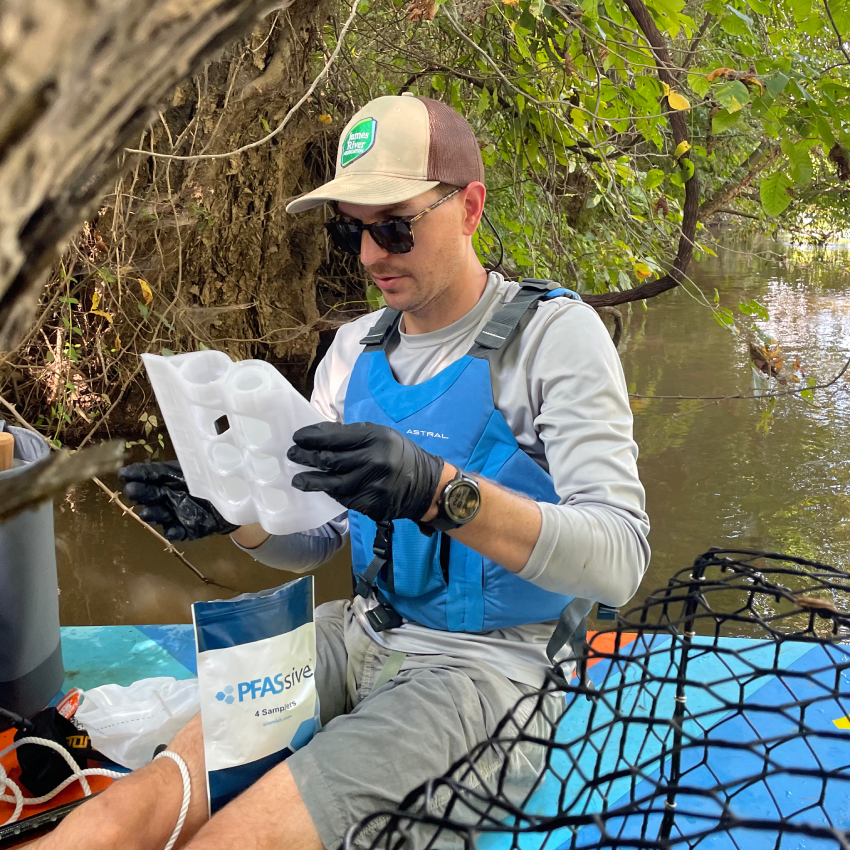
This Waterkeeper Alliance study of PFAS further evidences the widespread contamination in our waterways and sheds light on where PFAS are entering our environment, including wastewater treatment centers as well as areas where biosolids are applied to land commonly through agricultural practices. In Virginia, our James RIVERKEEPER conducted sampling both the Appomattox River and in Old Town Creek near Colonial Heights, where the presence of PFAS highlighted that trend.
PFAS have been found in our air, water, soil, and at detectable levels in the blood of nearly all Americans. (2) PFAS Chemicals have been linked with multiple serious human health issues, including certain cancers, reproductive issues, impacts to immune response, liver function, low birth weights, and more.
“Our results show that PFAS are present nearly everywhere we sample for them,” said Tom Dunlap, James RIVERKEEPER. “These man-made chemicals aren’t just showing up near industrial hotspots — they’re contaminating everything from major rivers to small creeks.”
This Waterkeeper Alliance report highlights the importance of addressing PFAS at both the federal and state levels and includes recommendations for things that could be incorporated at the state level to provide greater protections. One example is that the EPA has released a list of industries likely to release PFAS into our lakes, rivers, and streams (3) – but currently Virginia does not require monitoring or reporting for PFAS in effluent discharge permits from these facilities. The State has the authority today to make this happen, and so far has not taken action.
Likewise, Virginia could require PFAS testing in biosolids, coming from our wastewater treatment plants, before they are spread on the landscape. Using biosolids on farmland to improve the soil has been a practice for decades, and has served as a practical solution for land managers and our modern society, but we own it our farmers, to our communities, to test these biosolids for PFAS and other contaminants before they make their way into our food supplies.
Dunlap said, “If we’re serious about protecting our water and our health, we need to throw everything we’ve got at this widespread problem, including establishing limits for PFAS in our discharge permits and in biosolids going on farmland.”
1. https://waterkeeper.org/news/new-analysis-finds-pfas-in-98-of-tested-u-s-waterways-across-19-states/
2. https://pmc.ncbi.nlm.nih.gov/articles/PMC4483690/

ABOUT THE JAMES RIVER ASSOCIATION: The James River Association is a member-supported nonprofit organization founded in 1976 to serve as a guardian and voice for the James River. Throughout the James River’s 10,000-square mile watershed, the James River Association works toward its vision of a fully healthy James River supporting thriving communities. The James River Association believes that “when you change the James, the James changes you”. With offices in Lynchburg, Richmond, Williamsburg, and Scottsville, the James River Association is committed to protecting the James River and connecting people to it. For more information visit www.thejamesriver.org.