STATEMENT UPDATE
November 12, 2025
CONTACT:
Tom Dunlap
James Riverkeeper
tdunlap@thejamesriver.org
804-905-9724
Update as of 11/12/2025:
Crews continue working to remove train car debris and coal at the train derailment site east of the City of Richmond, in the Chickahominy and surrounding wetlands. The rail line was reconnected last week, allowing passenger and freight travel to resume, and staging of debris and removal is underway.
State and federal agencies, including the Virginia Department of Environmental Quality and the U.S. Environmental Protection Agency, remain actively involved in the response, though rainfall in the area and upstream has complicated clean up efforts. Containment measures have been deployed in the wetlands and the river to address diesel fuel and coal released in the crash. These include silt fencing, turbidity curtains, and sorbent containment booms that float on the water’s surface. Next steps will include the creation and approval of a Corrective Action Plan for coal remediation and a Wetlands Restoration Plan.
JRA looks forward to continued coordination with the agencies to restore the Chickahominy.
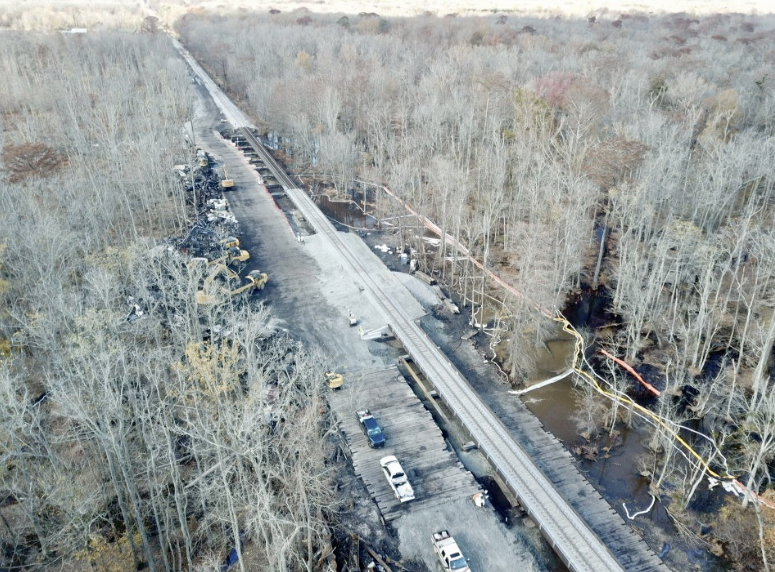
Containment measures visible around the site of the derailment. Debris staging on south side of the train tracks.
Photo credit: James River Association
PRESS STATEMENT
October 28, 2025
CONTACT:
Tom Dunlap
James Riverkeeper
tdunlap@thejamesriver.org
804-905-9724
James River Association Voices Concern About Environmental Impact of Coal Train Derailment in the Chickahominy River
On Saturday, October 25th, more than 50 rail cars carrying coal derailed east of Richmond at the border between New Kent and Charles City Counties. The derailment occurred in a remote area near the Chickahominy River, releasing many tons of coal into surrounding wetlands and tributaries. Two train engines involved in the crash released potentially thousands of gallons of diesel fuel into the area.
“We are deeply concerned about the impacts to the Chickahominy River, surrounding wetlands, and the people who work and live around the derailment site. The Chickahominy is a unique and critical tributary of the James River and the greater Chesapeake Bay, providing critical environmental benefits and habitat to plants and wildlife,” said Tom Dunlap, James Riverkeeper at the James River Association. “Many of the neighboring property owners have spent years or decades working on conservation practices to protect this area for the important resource that it is, and seeing this happen is a punch in the gut.”
The Department of Conservation and Recreation identifies the area where this crash occurred as in the top 3.5% of all lands in Virginia for ecological core value, reflecting its importance for rare species habitat, habitat diversity, ecosystem resilience, and water quality*. The sections of the Chickahominy downstream of the impacted area include conserved lands serving as a refuge for sensitive freshwater mussels and underwater grasses, as well as nursery habitat for native species, including imperilled migratory fish. This is in addition to the fact that the Chickahominy River is the source of drinking water for numerous communities on the lower Peninsula including Newport News.
Although the extent of environmental damage is still being assessed, safeguarding our natural resources must be a top priority. With the current federal shutdown looming, federal partners may not be able to continue their involvement in this effort, beginning as early as November 1st. This crash comes less than a week after the release of the James River Association’s biannual State of the James river health report card, and just over 10 years after the James River caught fire due to another significant train derailment in Lynchburg, VA.
“The coal train spill in the Chickahominy is yet another reminder that accidents like this can threaten river health and some of our most indispensable natural resources in the Commonwealth, and that continued investment in and maintenance of our infrastructure are essential prevention tools. In the coming days and weeks, we will continue to closely monitor the situation and work with partners to assess the damage and ensure appropriate followup actions are taken,” said Tom Dunlap, James Riverkeeper at the James River Association.
As the response effort unfolds involving the removal of the wreck, reconstruction of the Amtrak and CSX rail infrastructure, containment and remediation of pollutants, and investigation into incident causes, the James River Association urges all precautions be taken to mitigate the impact on the fragile swamplands.
*Department of Conservation and Recreation’s Virginia Natural Heritage Data Explorer: https://vanhde.org/content/map
ABOUT THE JAMES RIVER ASSOCIATION: The James River Association is a member-supported nonprofit organization founded in 1976 to serve as a guardian and voice for the James River. Throughout the James River’s 10,000 square mile watershed, the James River Association works toward its vision of a fully healthy James River supporting thriving communities. The James River Association believes that “when you change the James, the James changes you”. With offices in Lynchburg, Richmond, Williamsburg, and Scottsville, the James River Association is committed to protecting the James River and connecting people to it. For more information visit www.thejamesriver.org.