PRESS RELEASE
FOR IMMEDIATE RELEASE:
June 22, 2026
CONTACT:
Shannon Orcutt
Government Affairs and Policy Manager
sorcutt@thejamesriver.org
Historic $721.6M for Clean Water Funding Marks Major Step Forward, While Critical Gaps Remain
James River Association (JRA) today applauds the Virginia General Assembly for delivering the largest clean water investment in the Commonwealth’s history, marking a watershed moment for rivers and communities across the state.
“Today is a historic moment for Virginia’s rivers. This budget is the kind of investment that will make a real difference for communities and ecosystems across the Commonwealth. We are grateful to state leaders for making this level of investment, and we look forward to ensuring it delivers lasting benefits to the James,” said Bill Street, President and CEO of James River Association. “At the same time, the budget still needs to be approved by Governor Spanberger and even that will not be the finish line, as continued commitment will be needed to meet the scale of the challenges facing our waterways.”
Record Investment to Reduce Pollution in Rivers Across the Commonwealth
The final budget provides $721.6 million across wastewater, agriculture, and stormwater pollution reduction programs, marking a historic commitment to improving water quality across Virginia. This includes: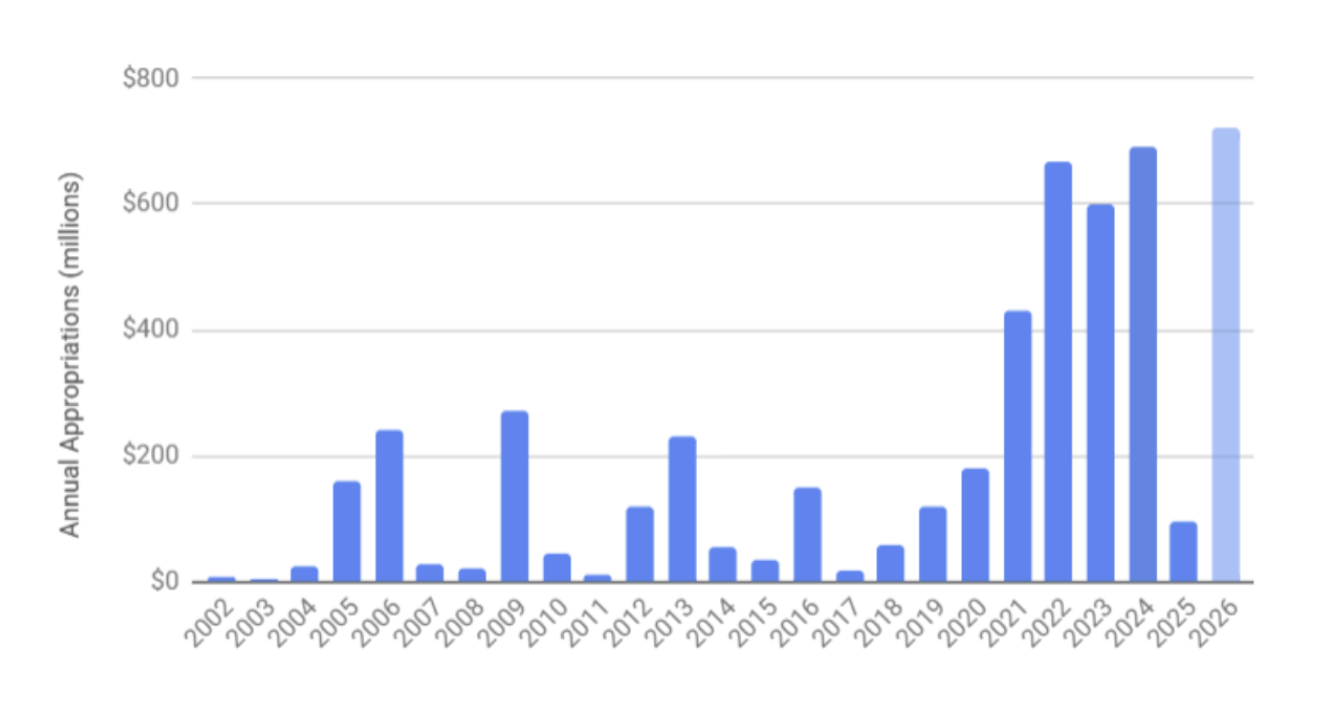
- $329.5 million for wastewater infrastructure
- $294.6 million to help farmers implement conservation practices
- $50 million for Richmond’s combined sewer overflow system
- $47.5 million for stormwater management including $43.5M for the Stormwater Local Assistance Fund and $4M for the Virginia Conservation Assistance Program
Together, these investments aim to reduce pollution from entering Virginia’s rivers and the Chesapeake Bay, improving water quality to strengthen the health and resilience of communities and ecosystems alike.
Direct Investments Target Long-Term Water Security
The budget also advances several long-term water protection priorities. New provisions establish PFAS monitoring and reporting programs while others explore safer disposal alternatives, helping Virginia better understand and respond to emerging contaminants. Additional investments support regional water supply planning to improve long-term water security, advance the beneficial reuse of dredged materials to support restoration efforts, and bolster environmental protections through the Hazardous Substance Storage Tank Program.
Shoosmith Landfill Gets $10.6M: A Critical First Step but More is Needed
The budget takes an important initial step toward addressing the urgent environmental risk at the Shoosmith Landfill in Chesterfield, with $10.6 million allocated for site stabilization. While this is a critical down payment, it represents only a fraction of the total cleanup needed, which is estimated to cost $173 million. Additional investment will be necessary to fully protect water quality of the adjacent Swift Creek and communities downstream as it flows into the James River.
Critical Funding Gaps Threaten Clean Water Progress
Despite the historic investment, several key issues and programs remain unaddressed or underfunded:
- Funding for Virginia Trees for Clean Water was reduced by 87%, which along with the Department of Forestry Water Quality Grants were each funded at $500,000, while proposed funding for two community forestry positions was removed entirely. This is far below what is needed to scale riparian buffers, community tree planting, and other nature-based solutions to tackle stormwater pollution statewide.
- Environmental literacy funding remained level at $250,000, despite more than $1.4 million in requests for Meaningful Watershed Educational Experiences (MWEE) in 2025, leaving many students without the hands-on education needed to build the next generation of water stewards.
- The budget removed an opportunity to address the growing problem of invasive blue catfish, which are driving population declines of Virginia’s migratory fish. Two House committee amendments supporting management and marketing efforts were stripped from the final budget.
- In the face of rapid data center growth, lawmakers did not enact the necessary guardrails to protect the environment, including water supply and quality.
JRA has seen notable improvements to the health of the James River over its 50 years and will continue to work with state and local leaders to ensure these investments translate into measurable improvements for Virginia’s waterways and advance solutions to the threats that remain.
ABOUT THE JAMES RIVER ASSOCIATION:
James River Association (JRA) is a member-supported nonprofit organization founded in 1976 that serves the waterways and communities of the James River. Throughout the James River’s 10,000 square mile watershed, JRA works toward its vision of a fully healthy James River supporting thriving communities. JRA believes that “when you change the James, the James changes you.” With offices in Lynchburg, Richmond, Williamsburg, and Scottsville, JRA is committed to protecting the James River and connecting people to it. For more information visit www.thejamesriver.org.